AI Workslop: The Cost of Speed Without Thought
[Mic Drop]: When we reward teams for how fast they hit 'send' rather than how deeply they think, 'workslop' is the tax we pay. That tax, estimated to be at around $9 million annually for large organizations, isn't an AI issue; it's a leadership issue. If we want to reclaim that lost time and capital, we have to stop celebrating the illusion of speed and start demanding the friction of thought.

A leadership team gets a strategy deck turned around overnight. It reads clean, the storyline holds, and everyone signs off.
Two weeks later, the same leaders are back in a room undoing the work, reclarifying priorities, re-aligning teams, and reopening decisions that were meant to be settled. The organization did not move faster. It just moved twice.
This is what speed without judgment produces. Thinking quietly gets offloaded, not out of laziness, but because the output comes so quickly and sounds so coherent that it passes without challenge.
Generative AI did not create this dynamic. It amplified it.
GenAI makes it effortless to generate drafts, decks, and strategy language at scale. The problem is not that the work looks bad. The problem is that it looks finished.
Speed did not remove work. It multiplied workslop, polished output that creates downstream cleanup, and slows real progress.
AI Workslop, the Productivity Trap No One Names
Workslop refers to AI-generated output that appears complete but lacks value. Examples include emails with formal language but no clear updates, well-designed slide decks with vague recommendations and no actionable steps, or analyses that use data but omit essential context. This work may pass initial review but causes confusion when used.
This is not rare. Recent research from BetterUp found that around 40 percent of employees believe they have received workslop in the last month. Managers are even more exposed, with more than half reporting that the AI-generated work they received required clarification, correction, or cleanup. On average, employees estimate that more than 15 percent of the work they receive now falls into this category.
The cost is not just an annoyance. Workers report spending nearly two hours per instance untangling workslop, often more time than it would have taken to do the work properly in the first place.
The damage is also social. Recipients describe feeling frustrated, confused, and less trusting of the sender, quietly revising their assessment of that person's judgment and reliability.
We aren't just talking about a minor shift in workplace etiquette; we are talking about a massive, silent financial drain. A joint study by BetterUp and the Stanford Social Media Lab recently laid out the staggering reality of this tax on productivity:
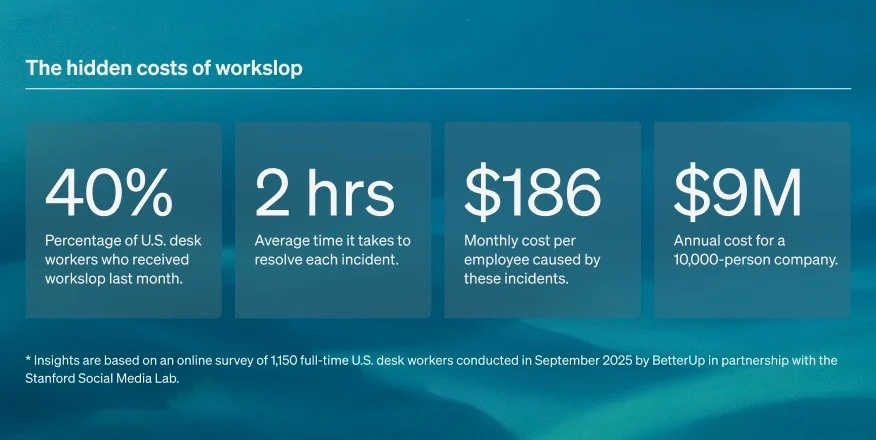
A $9 million annual tax on a large enterprise isn't a software issue; it's a culture issue. It happens when leaders reward the speed of an output rather than the clarity of the outcome. To reclaim that lost time and capital, we have to change what we celebrate.
Workslop looks productive. It sounds polished. And that is exactly why it spreads.
Why Workslop Spreads
Workslop spreads because friction disappeared. Friction used to be where thinking happened. It forced questions, debate, and discomfort. Now output arrives so quickly that reflection feels inefficient. The unspoken rule becomes clear. Do not slow things down. Do not overthink it. Just deliver.
GenAI rewards this behavior. It produces answers that sound right, look complete, and arrive quickly. Over time, speed signals competence, while judgment fades.
Teams stop asking whether something is good. They only ask whether it is done, and this is how workslop becomes normal.
The Real Leadership Gap
Workslop is not a prompting issue. It is not a tooling issue. It is a leadership issue. Specifically, it shows up when leaders stop asking hard questions.
Not because they do not care, but because speed feels urgent and thinking feels optional. In fast systems, inquiry feels like friction. And friction is exactly what judgment requires.
AI does not challenge assumptions unless someone forces it to.
The Antidote: Asking Hard Questions Again
Workslop does not survive scrutiny. It survives silence. Leaders who avoid it slow fast work just enough to interrogate it. They treat AI output as raw material, not as conclusions.
They ask questions like:
What is conveniently absent?
What must be true for this to work?
What decision are we committing to if we accept this?
Where does this fail first?
What would improve if we deleted half of this?
These questions do three things at once as they expose cognitive offloading, reinsert accountability, and slow work just enough to restore judgment.
Final Drop: Speed Scales Whatever You Value
Speed amplifies priorities, whether you choose them or not. If clarity matters, speed helps. If appearance matters, speed produces slop.
GenAI did not make the work shallow. It simply removed the last excuses for not thinking deeply. In an AI-saturated workplace, leadership is no longer about moving faster.
Pause, ask the tough questions, and demand clarity before moving forward. Choose depth over speed and make reflection a standard practice today.
+++

If you want to improve your leadership skills, broaden your impact inside your organization and beyond, or simply require an experienced outside partner, then please book an initial, no-obligation chat here.